🗂️Data Model & Architecture
🧩 Sample Employee Data Model – Entity Relationships
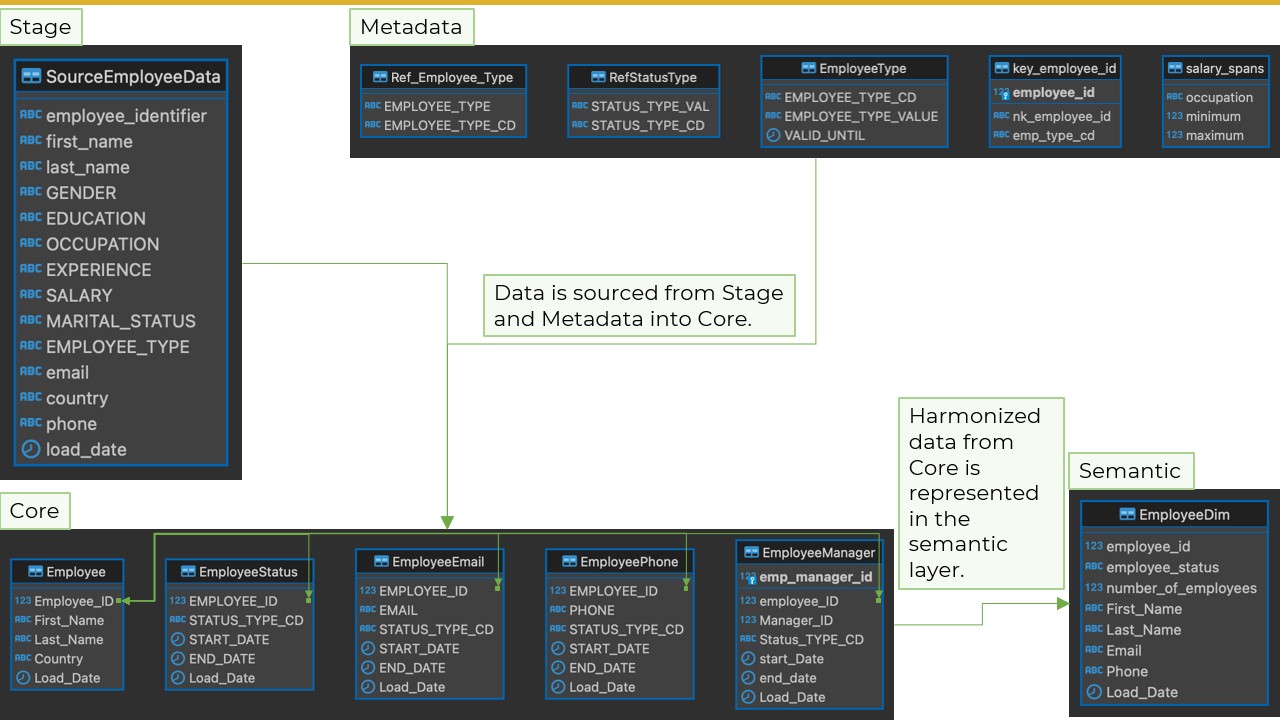
This diagram shows a simplified employee data model, illustrating key entities and their relationships across the Stage, Metadata, Core, and Semantic layers.
- 📥 Stage — Contains raw, source-aligned data structures such as
SourceEmployeeData. - 📚 Metadata — Stores reference and lookup tables (e.g.,
Ref_Employee_Type,RefStatusType) that define controlled vocabularies and classifications. - ⚙️ Core — Holds harmonized, integrated data structures (
Employee,EmployeeStatus,EmployeeEmail, etc.) sourced from Stage and Metadata. - 📊 Semantic — Represents the curated, business-ready view of the data (
EmployeeDim).
➡️ Arrows indicate data flow between layers, with transformations applied as data moves from raw ingestion to harmonized datasets.
🏛 Sample Employee Data Model – Layered Architecture
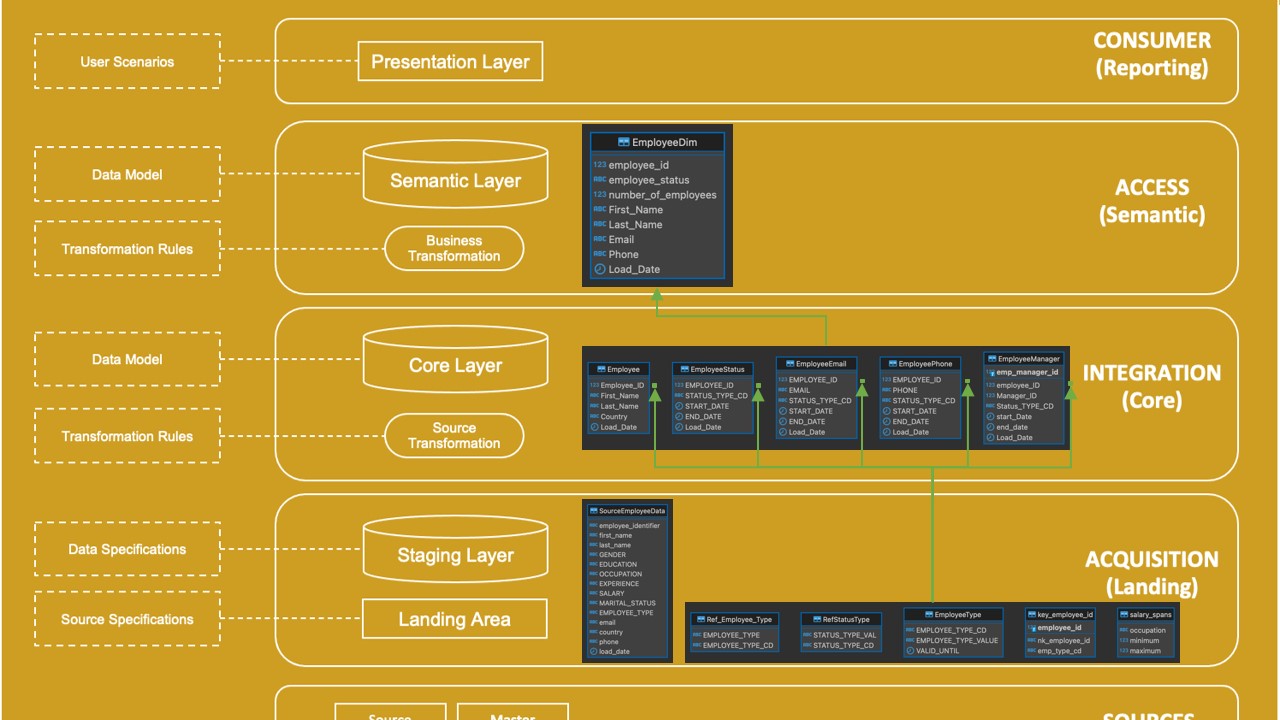
This diagram places the employee data model within a broader data architecture framework:
- 📥 Acquisition (Landing & Staging) — Captures raw data from source systems and applies initial standardization.
- 🔄 Integration (Core Layer) — Stores harmonized data structures after applying transformation logic.
- 📊 Access (Semantic Layer) — Applies business transformations to produce analysis-ready datasets.
- 👨💼 Consumer (Presentation Layer) — Provides data for reporting, analytics, and downstream applications.
✅ Purpose: This layered view ensures traceability and consistency at every stage, showing how data progresses from acquisition to final presentation.