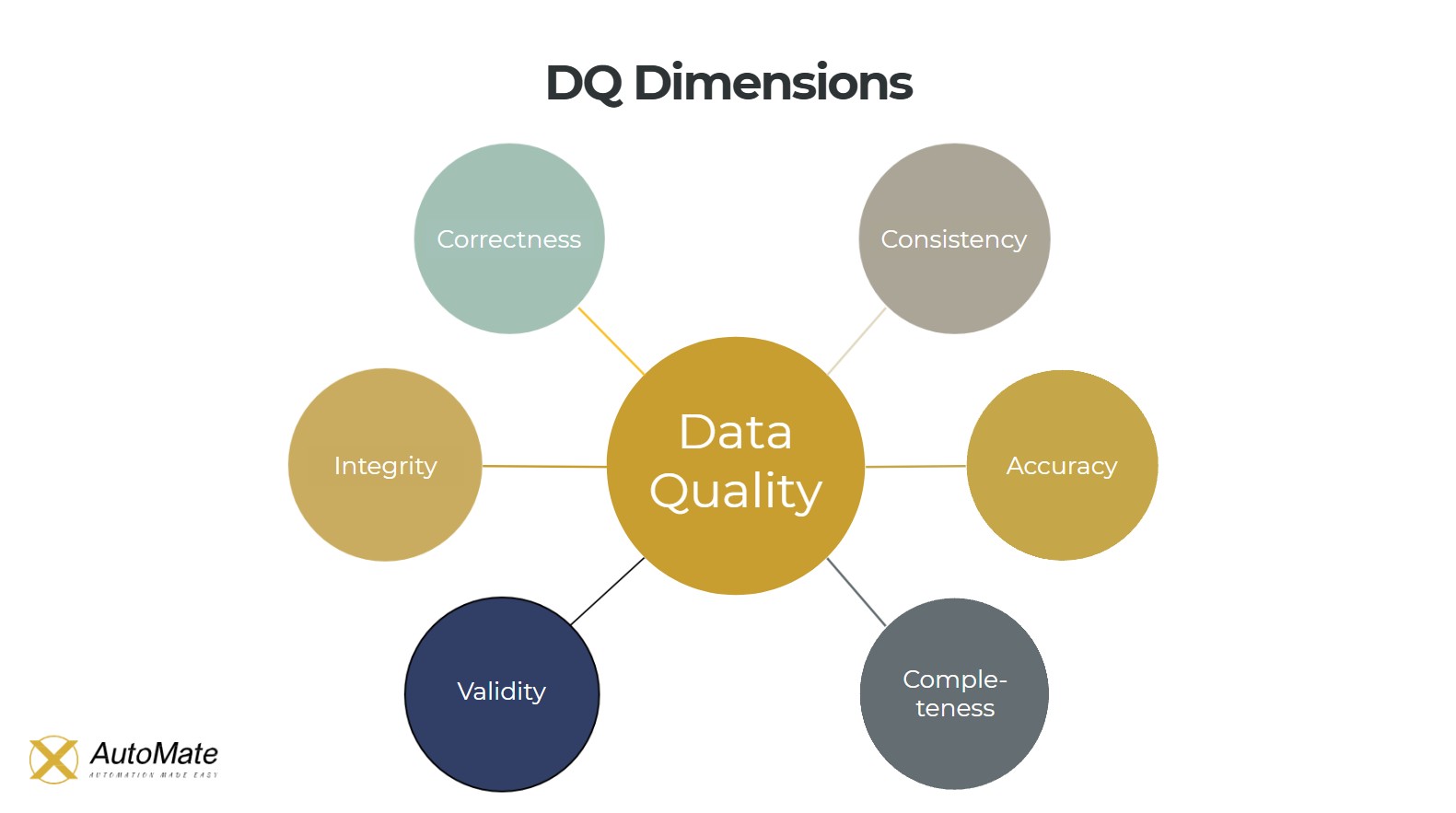
📊 DQ Dimensions
Data Quality Dimensions represent the fundamental perspectives from which the health and fitness of data are assessed. They provide a structured vocabulary for identifying, categorizing, and addressing quality issues, ensuring that discussions about “data quality” are precise and measurable rather than abstract.
In our UI, each dimension acts as a category under which DQ checks and measurements are aggregated, allowing both technical and business stakeholders to interpret results in the same context. For example, a “Completeness” percentage in the dashboard doesn’t just mean “some values are missing” — it reflects all tests related to missing fields, missing records, or incomplete reference datasets, grouped together under a business-relevant quality perspective.
The seven dimensions tracked in the UI — ✅ Correctness, 🔄 Consistency, ⏱ Timeliness, 🎯 Accuracy, 📦 Completeness, 📏 Validity, and 🔗 Integrity — form the backbone of our quality monitoring process.
✅ Correctness
Definition: Measures whether data values are correct for their intended business context, based on trusted sources or predefined business rules. Correctness is about the truthfulness of data in relation to real-world values.
Why it matters: Incorrect data leads to operational errors, flawed decisions, compliance violations, and customer dissatisfaction.
Examples:
- 💰 Product price in the database matches the official price list published by the finance department.
- 🌍 Country codes in the system match ISO-3166 standard values.
- 🏙 Customer postal code correctly corresponds to their registered city.
Note: Some frameworks group Correctness under Accuracy; in our UI, it is tracked separately for better granularity.
🔄 Consistency
Definition: Ensures that data remains uniform and free from contradictions when compared across different datasets, systems, or time periods.
Why it matters: Inconsistent data causes reporting mismatches, breaks integrations, and reduces confidence in analytics.
Examples:
- 📊 The
total_amountin theOrderstable matches the sum of line item amounts inOrderLines. - 🧾 Gender is stored as
M/Fin one database andMale/Femalein another — these must be harmonized. - 🏠 A customer’s address is stored differently in CRM and billing systems.
⏱ Timeliness
Definition: Measures whether data is available within the required timeframes defined by SLAs or business rules.
Why it matters: Even accurate data loses value if it is not available when needed for decision-making or automated processes.
Examples:
- 📅 Daily sales transactions must be available by 6:00 AM to feed morning business dashboards.
- 📡 Real-time sensor readings must be ingested within 5 seconds to trigger safety systems.
- 🗓 Monthly reports must be generated before the 5th business day of the next month.
🎯 Accuracy
Definition: Measures how closely data values match actual real-world facts or a reliable reference source.
Why it matters: Inaccurate data erodes trust and can cause costly errors in operations, planning, and compliance.
Examples:
- 🆔 Customer’s date of birth in the system matches their government-issued ID.
- 📍 Recorded GPS coordinates match the actual physical location of a store.
- 📈 The CPI (Consumer Price Index) stored matches the official figure from the statistical office.
📦 Completeness
Definition: Evaluates whether all required data is present — including full datasets, mandatory fields, and all relevant reference values.
Why it matters: Missing information reduces analytical reliability and can stop business processes from running.
Examples:
- 🚫 A sales order is missing the
customer_id— preventing invoice generation. - 📋 The
statusreference table lacks an expected value like “Suspended”. - 📧 Customer records without email addresses make it impossible to send notifications.
📏 Validity
Definition: Checks whether data values conform to the required format, range, or domain specified by business rules, data models, or regulations.
Why it matters: Invalid data can cause process failures, calculation errors, or misclassification in analytics.
Examples:
- 📮 Email addresses must match the pattern
^[a-z0-9._%+-]+@[a-z0-9.-]+\.[a-z]{2,}$. - 🎂 The
agefield must be between 18 and 120. - 🚚 Order status must be one of
('NEW', 'PROCESSING', 'SHIPPED', 'CANCELLED').
🔗 Integrity
Definition: Ensures that relationships between data entities follow defined constraints — typically referential integrity (foreign key relationships) and cardinality rules.
Why it matters: Missing or incorrect links create orphaned records, break joins in reporting, and distort aggregated metrics.
Examples:
- 🛒 Every
order.customer_idmust exist in thecustomers.customer_idtable. - 🆔 No employee can have more than one active ID badge when the relationship is 1:1.
- 🗂 Product records must link to an existing category in the
categoriestable.
📌 Mapping of DQ Dimensions to X-AutoMate DQ Checks
This mapping links the Data Quality Dimensions used in our UI to the corresponding X-AutoMate DQ Check categories.
It ensures that technical tests are always aligned with the business meaning of each dimension.
| DQ Dimension | Relevant X-AutoMate Test Approaches | Purpose / Examples |
|---|---|---|
| ✅ Correctness | value_out_of_range, value_maximum, value_minimum, custom_query | Verifies correctness against trusted sources. Examples: product_price matches price list, postal_code matches city, VAT rate matches legal rate. |
| 🔄 Consistency | attribute_mapping, processing_delta, processing_full_dump, processing_history | Prevents contradictions across systems. Examples: order_total matches sum of items, status codes match across CRM/ERP. |
| ⏱ Timeliness | processing_fresh | Ensures SLA compliance. Examples: data updated daily, DB loads before 6 AM, sensor data ingested within seconds. |
| 🎯 Accuracy | aggregation_count, aggregation_custom, reconciliation_count, value_out_of_range | Confirms closeness to real-world values. Examples: exchange_rate matches central bank, GPS within tolerance, birth_date matches ID. |
| 📦 Completeness | value_missing_null, value_empty, value_empty_custom, value_missing_custom | Ensures no missing data. Examples: all customers have IDs, all statuses are present, all branches report sales. |
| 📏 Validity | structure_discovery_email, structure_discovery_phone, structure_discovery_datetime, value_illegal, value_custom, custom_query | Validates format/range/domain. Examples: email regex, age range, valid status list. |
| 🔗 Integrity | refferential_integrity, reconcilation_e2e | Ensures valid relationships. Examples: all orders link to customers, no orphaned children, valid category IDs. |
Notes:
- Each test result is tagged with its mapped dimension so dashboard percentages reflect the correct quality aspect.
- Additional checks may also align with these dimensions depending on business rules.