🔑 Surrogate Keys
Surrogate Keys are specially generated identifiers used instead of natural business keys (like SSN, tax numbers, or other business identifiers).
Their correctness ensures consistent joins, referential integrity, and efficient operations in your data warehouse.
📌 Why?
- 🏎 Enable consistent, high-performance joins in fact and dimension tables—even when business keys are long, change over time, or are not unique across systems.
- 🔄 Allow you to manage changes in natural business keys (e.g., customer number changes, ID replacements, or mergers) without breaking links in reporting and analytics.
- 🛡 Decouple your internal data warehouse logic from external natural keys, reducing risk of breaking downstream logic due to upstream changes.
📍 Where?
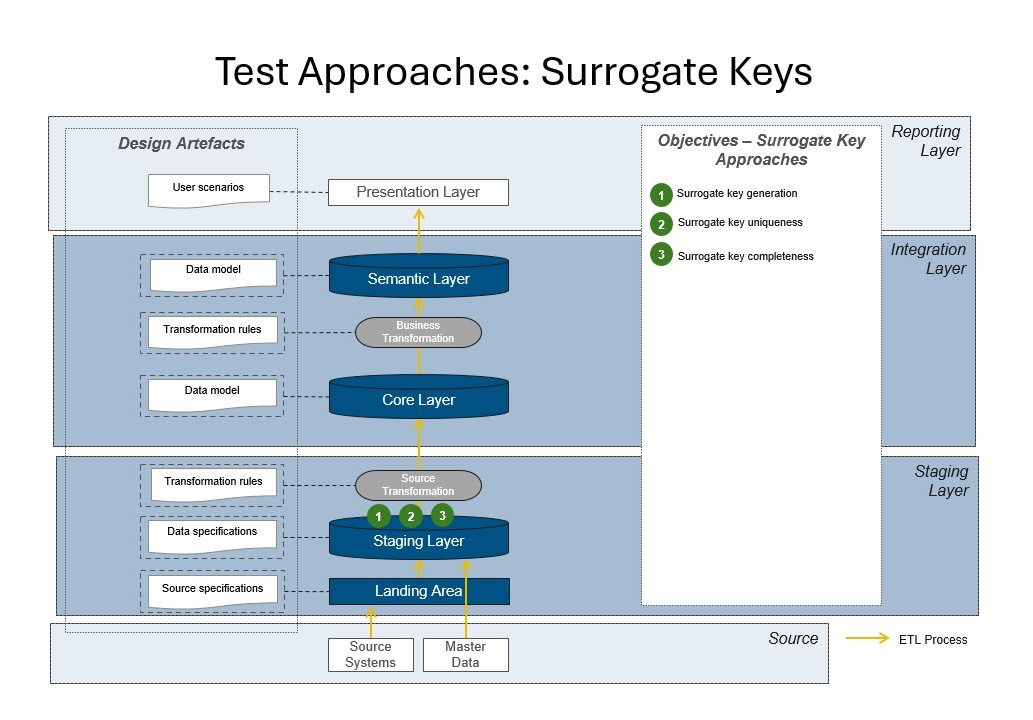
- Mainly in the Staging layer (where business keys are mapped to surrogates),
but they are critical throughout all fact and dimension tables.
🛠 Methods
1. 🏗 Generation
Ensure that a surrogate key is generated and assigned for every natural key in staging or source data.
Description:
This check verifies that every record entering a dimension table through ETL receives a surrogate key. Missing surrogate keys mean facts cannot be reliably linked to dimensions, breaking star schema joins and causing missing or orphaned records in reports.
Why is this important?
Without a surrogate key, records cannot join across layers—resulting in lost or untraceable data in analytics and dashboards. This is especially important when integrating legacy data or adding new sources.
Example:
SELECT nk_id
FROM stage_table
WHERE nk_id NOT IN (SELECT nk_id FROM dim_table);
2. 🔍 Uniqueness
Verify that each natural key maps to exactly one surrogate key.
Description:
Ensures a 1:1 relationship between business keys and surrogate keys.
Multiple surrogate keys for the same business key create duplicate dimension records, inconsistent reporting, and broken fact relationships.
Why is this important?
Data integrity depends on only one surrogate key per entity. If more exist, historical tracking (Type 2 SCD) and analytics will be inaccurate.
Example:
SELECT nk_id, COUNT(*)
FROM dim_table
GROUP BY nk_id
HAVING COUNT(*) > 1;
3. ✅ Completeness
Ensure no NULL surrogate keys exist in the dimension table.
Description:
Confirms that every row in the dimension table has a valid surrogate key.
NULL values usually signal incomplete ETL logic, mapping errors, or failed key assignments.
Why is this important?
NULL surrogate keys break referential integrity, causing join failures and orphaned records in reporting.
Example:
SELECT *
FROM dim_table
WHERE surrogate_key IS NULL;